
Facts about Blood Donation, Benefits, Myths, Blood Groups

Our readers, especially the students/young people, must know about some important facts related with Blood Donation. Even there are questions in the Exams related with Blood Donations. Here we are providing you complete details regarding Blood Donation – Facts, Benefits for the donors, Myths behind donating blood and information related with various blood groups.
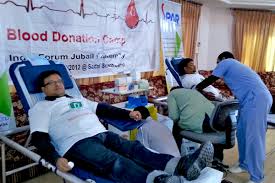
Facts about Blood Donation

Ill-knowledge regarding Blood Donation causes dilemma among the would-be blood donors.  In this blog, we will first tell you as to why Blood Donation is necessary.


Why is Blood Donation is must ?
1. You can save the life of the needy.
2. Production of Blood is not possible nor is there any substitute possible of it. Donation is the only alternative.
3. In India, we need 40 million unit of 250 cc whereas we only get 5 lac unit blood.
4. In our body there is only 7% blood of the total weight of it.
5. As per the statistics, more than 25% people need blood in their lives.


Benefits of Donating Blood –

  1. People who are thinking to donate blood may want to know about benefits of Blood Donation. May be this fact encourage more and more people to come out donate blood.
  2. Blood Donation reduces the risk of heart-attack. Doctors believe that donation thickens blood which is good for heart.
  3. As per the latest researches, a regular donor has less danger of getting inflicted with cancer and other fatal diseases. The reason is that donation emits toxics found in human body.
  4. Bone-marrow creates new blood cells after the donation. So the body gets new blood cells besides activeness.


Myths regarding Blood Donation –
There are many myths that discourage people to do this one of the greatest donations of the world. Here are some –

It causes weakness –
  • No it doesn’t cause weakness of any type. After donating blood, you can work as earlier. It doesn’t cause deficiency of any type in the body.
  • Second, it is a safe and healthy tradition. The blood is compensated within 21 days. Even the body makes up the blood volume from 24 hours to 72 hours.


What to do/not do before donating blood ?
  1. There is the mini blood test before the donation. In this test, hemoglobin, blood pressure, weight, sugar etc are checked. There are also the test for Hepatitis B and C, HIV, Malaria etc. Such persons suffering from such problems are not eligible for blood donation.
  2. Only those who are more than 18 with weight 50 kg or more can donate three or four times in a year.
  3. If only 3% of the total eligible people donate blood, there shall be no dearth of blood in the blood banks in the country. There shall be no death due to shortage of blood.
  4. The donor must not smoke a few hours before or after the blood donation.
  5. A person who wishes to donate blood must not drink 24 to 48 hours before the donation.
  6. He/she must give correct answers to the queries by the doctor.


 ( Nature of Blood Groups) – Receivers from others.

  1. O- Group can only receive
  2. O+ Group person can take blood from O+ and O-
  3. A – Group can take blood from A- and O-
  4. B- can take blood from B- and O-
  5. B+ from B+, B-, O+ and O-
  6. AB- from AB-, B-, A- and O-
  7. AB+ from AB+, AB-, B+, B-, A+, A-, O+ and O-

So get ready to donate blood.
Allow your blood to run in others’ veins, the best way to live in others.

Comments

Popular posts from this blog

The Difference Between Being Intelligent And Being Wise

Intelligent : •   wise, cunning, capable of thinking and reason Wisdom: • The state of being wise • Ability to use knowledge and / or experience wisely • Able to determine what is wise against what is unwise • A saying, a philosophy or other advice considered wise In Short:  An intelligent man has a whole sea of knowledge and knows every fact. On the other hand, a wise man does not have all the knowledge that an intelligent man has, but he has the brain to know when to use knowledge. I have seen a lot of smart people make really stupid decisions. I was one of those people! The information I had before and after these decisions has not changed. But with every wrong decision, if I was willing to learn, my level of wisdom changed. The main difference is that: A smart or intelligent person knows how to solve any problem. A wise person knows how to avoid this problem. Knowledge makes a person intelligent. Experience makes a person wise.

Silt

Silt is granular material of a size somewhere between sand and clay, whose mineral origin is quartz and feldspar. Silt may occur as a soil or as sediment mixed in suspension with water (also known as a suspended load) in a body of water such as a river. It may also exist as soil deposited at the bottom of a water body. Silt has a moderate specific area with a typically non-sticky, plastic feel. Silt usually has a floury feel when dry, and a slippery feel when wet. Silt can be visually observed with a hand lens. Sources:- Silt is created by a variety of physical processes capable of splitting the generally sand-sized quartz crystals of primary rocks by exploiting deficiencies in their lattice. These involve chemical weathering of rock and regolith, and a number of physical weathering processes such as frost shattering and haloclasty. The main process is abrasion through transport, including fluvial comminution, aeolian attrition and glacial grinding. It is in semi-arid envir...

Electric Flux

Electric field can be quantitatively described by using the concept of electric flux. Electric flux is the number of electric field lines penetrating a surface or passing through a surface. The electric field can be uniform or non-uniform. Let us now try to find the electric flux passing through a surface when the field is uniform.

The average temperature of the planets

Within the Solar System, the average temperature on: • Pluto is around -235°C, • Neptune around -220°C, • Uranus -210°C, • Saturn -184°C, • Jupiter -153°C. • The temperature on Mars varies between about -87°C and -5°C, with an average of around -46°C. • The lowest natural temperature on Earth (recorded at Vostok, Antarctica in 1983) is -89°C; the highest surface temperature on Earth (recorded at Al 'Aziziyah, Libya in 1922) is 58°C; the mean overall temperature on Earth is 14°C. Planet Biography. Planets Surface Temperatures. Why temperatures differs from planets to planets? In general, the surface temperature decreases as the distance from the sun increases. Venus is an exception because its dense atmosphere acts as a greenhouse and heats the surface above the lead's melting point of 880 ° F (471 ° C).

Why Are Planets Round?

Our Solar System. Big, small but round. But, why all the planets and stars are round?  The eight planets in our solar system differ in many ways. They are of different sizes. They are different distances from the sun. Some are small and rocky, and others are large and gaseous. But all are nice and round. Why is that? Why don't they have cubes, pyramids or discs? Planets are round because of a process known as "spherical shape formation". This process is caused by the forces of gravity and centrifugal force. Gravity is the force that pulls all objects towards the center of mass. The stronger the gravity, the more compact an object will be. As a planet forms, the gravity of all the matter within it causes it to pull together and become denser. This results in the planet becoming more and more spherical in shape. Additionally, as a planet spins on its axis, the centrifugal force caused by this rotation also contributes to the spherical shape. ...

NEPTUNE FACTS

Planet: Neptune NEPTUNE IS THE EIGHTH PLANET OF THE SUN AND THE LAST OF THE KNOWN PLANETS. WHILE IT IS THE THIRD LARGEST PLANET WITH REGARD TO THE MASS, IT IS ONLY THE LARGEST FOUR IN DIAMETER TERMS. DUE TO HIS BLUE COLOR, NEPTUNE WAS APPOINTED AFTER THE ROMAN GOD OF THE SEA. FACTS ABOUT NEPTUNE • Neptune needs 164.8 Earth years to orbit the Sun. On July 11, 2011, Neptune completed its first full orbit since its discovery in 1846. • Neptune was discovered by Jean Joseph Le Verrier. The planet was not known by ancient civilizations because it is not visible to the naked eye. The planet was initially called Le Verrier after its discoverer. This name, however, was quickly abandoned and the name of Neptune was chosen instead. • Neptune is the Roman god of the sea. In Greek, Neptune is called Poseidon. • Neptune has the second largest gravity of any planet in the solar system, second only to Jupiter. • The trajectory of the orbit of Neptune i...