 |
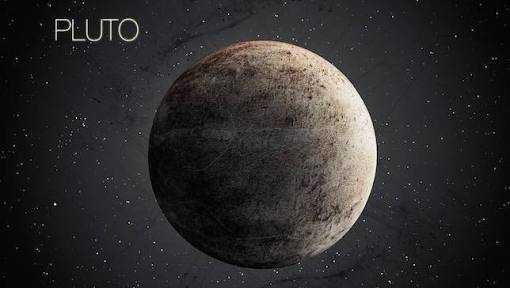
| Pluto. |

1: - The Sun looks 1600 times weaker from Pluto than from Earth.
2: - One year in Pluto is equal to 248 Earth years.
3: - Pluto has not finished an orbit since it was discovered in 1930, taking 248 years to go around the Sun.
4: - About 20 years ago, Pluto's moon, Charon, was discovered.
5: - A day on the planet Pluto is approximately the duration of a week on Earth.
6: - Sunlight takes 8 minutes to reach Earth, 12 minutes and 47 seconds to reach Mars, and 5.5 hours to reach Pluto.
7: - Until 2006 Pluto was considered one of the planets of our solar system, but since 2006 it is classified in a new category called "dwarf planets".
8: Pluto was discovered in 1930 by astronomer Clyde Tombaugh.
9: While it may seem obvious what a planet is, the definition has become more complex since 2006 when the International Astronomical Union voted to reduce Pluto's status (discovered in 1930 and considered a planet since then) to a dwarf planet, so That officially is no longer the ninth planet in the Solar System.
10: - Pluto is not a planet, because it does not have a fixed orbit and its orbit is between the orbit of another planet (Neptune).
11: - Due to its size, Pluto's moon, Charon, is also considered a double dwarf planet (two planets that orbit each other), instead of a moon that orbits its planet.
12: - The Earth-Moon size ratio is the largest in our solar system, except Pluto-Charon.
13: - Due to its size, Pluto's moon, Charon, is also considered a double dwarf planet (two planets that orbit each other), instead of a moon that orbits its planet.
14: - If you were standing in Pluto at noon, it would seem like a moonlit night here on Earth. The sunlight that reaches the degraded planet Pluto is 1,000 times weaker than on Earth.
15: - Many recent studies believe that Mars was hit by a body the size of Pluto about four billion years ago. The direct result of this coup was the Borealis basin that covers 40% of the planet.
16: - Pluto consists of rock with a very thick layer of ice.
Comments
Post a Comment